
● TEXAS VALUATION & BUSINESS VALUE · MANUFACTURING, MACHINE SHOPS & INDUSTRIAL
What a Texas Manufacturing or Machine Shop Business Sells For
Smaller owner-operated Texas manufacturing, CNC machine shop, and custom fabrication businesses commonly sell for ~2.8x–3.6x Seller’s Discretionary Earnings (SDE) (with $500K–$2M SDE deals averaging 2.8x–3.3x), while lower-middle-market industrial companies with a plant manager and diversified customer base commonly trade at ~4.0x–6.0x+ EBITDA (sources: IBBA / M&A Source Market Pulse Q4 2025, BizBuySell 2021–2025 benchmarks, and Pepperdine Private Capital Markets Report, checked ).
These are published market ranges, not a valuation of your business; a formal valuation requires a credentialed appraiser (when you need a formal appraisal). SweetSpot is not a broker. We don’t list businesses, find buyers or take a success fee. We work on the shop floor and in the books 1–3 years before an exit so your Texas plant commands an institutional multiple rather than an equipment-liquidation price.
Clear first step: Take the 5-minute online check ($0, no email required to see your score), or book a 30-minute working call directly on Daniel Sweet’s calendar.
Jump to the worked valuation example ↓ · Model your multiples in 60 seconds →
Texas Manufacturing & Industrial.
Valuation & Sale Readiness.
Related industrial guides & Texas metro exit-planning hubs:
DFW ManufacturingOilfield ServicesDFW exit planningHouston exit planningAustin exit planningSan Antonio exit planningESOP vs. MBOWhat It CostsHOW TO DO BUSINESS WITH US
Three fixed-fee ways to start — pick the step that matches your timeline.
No open-ended retainers and no broker listing contracts. Start online for free in 5 minutes, or book a 30-minute working call.
5-Minute Sale-Readiness Check
Score your recurring revenue quality, owner dependency, management depth, and clean financials online. Your score and 12-month payoff preview appear immediately on screen — no email required.
Start Free 5-Min CheckCustom 24-Page Field Guide
Built from your diagnostic answers and reviewed by a person before it ships: what to fix first, which false fixes waste money, and three 30-day actions. Backed by a 30-day full refund.
Order the $250 Field Guide Preview a 24-page sample ↓30-Min Working Call or Inspection
Need direct advisory on a tight timeline, or want us to audit your records ($2,500 Inspection) or work on site ($4,750 On-Site Diagnostic)? Start with a 30-minute working call.
Book a 30-Min Working Call Compare $2,500 Inspection vs. $4,750 On-Site →ILLUSTRATIVE WORKED EXAMPLE — NOT A FORMAL VALUATION
How a buyer calculates SDE, EBITDA, and implied price on a Texas precision manufacturer
SDE (Seller’s Discretionary Earnings) is net profit plus owner compensation, owner benefits, interest, taxes, depreciation, and documented one-time expenses, used for smaller owner-operated shops. EBITDA (Earnings Before Interest, Taxes, Depreciation, and Amortization) measures operating cash flow after paying a market-rate plant manager or GM, and is the standard metric for industrial companies above $1M in earnings (see full SDE vs. EBITDA guide).
Table A — Illustrative Earnings Build ($6.5M Revenue Texas Precision Fabrication & Machining Plant)
Illustrative, not a formal valuation. Shows how industrial buyers normalize tax-return net income into SDE and adjusted EBITDA.
| Line item | Amount | How buyers and lenders treat it |
|---|---|---|
| Reported net income (pre-tax) | $680,000 | Starting figure from CPA-reviewed financial statements and tax return. |
| + Owner W-2 compensation & benefits | +$260,000 | Added back in full for SDE; replaced by a market-rate GM/VP Operations salary for EBITDA. |
| + Depreciation (Section 179 / MACRS) & interest | +$240,000 | Added back to reach EBITDA, though buyers closely inspect maintenance capex vs. growth capex. |
| + Non-operating family payroll / one-time plant move cost | +$50,000 | Allowed only when backed by payroll records and vendor invoices. |
| = Seller’s Discretionary Earnings (SDE) | $1,230,000 | Total cash flow available to a working owner before debt service and capex. |
| − Market replacement cost for Plant General Manager | −$180,000 | Cost to hire an experienced industrial GM so the plant runs without the founder. |
| = Adjusted EBITDA | $1,050,000 | Institutional cash-flow base priced by lower-middle-market buyers, family offices, and PE groups. |
Table B — Illustrative Multiple Applied (Low / Median / High)
Illustrative, not a formal valuation. Demonstrates how customer concentration and shop-floor independence shift the multiple.
| Readiness profile | Earnings base used | Illustrative multiple | Implied enterprise value | Why it lands here |
|---|---|---|---|---|
| Low (Owner-quoted job shop + concentration) | $1,230,000 SDE | 2.8x SDE (~3.3x EBITDA) | ~$3,444,000 | Top customer accounts for 38% of revenue; founder quotes every complex job from memory; aging manual/CNC machines. |
| Median (Well-run regional contract manufacturer) | $1,050,000 EBITDA | 4.3x EBITDA | ~$4,515,000 | Shop foreman and estimator in place, no customer over 18%, clean WIP and raw-material inventory counts. |
| High (Repeat production + transferable plant team) | $1,050,000 EBITDA | 5.6x EBITDA | ~$5,880,000 | Passes 90-day owner absence test, ISO/AS9100 quality system, multi-year blanket POs, modern well-maintained equipment. |
WHAT MOVES THE MULTIPLE
Six factors that push a Texas manufacturing multiple up or down
Industrial acquirers and SBA / commercial acquisition lenders scrutinize six operational areas during diligence. Fixing these before you go to market (see Before You Hire a Broker) protects both your multiple and your cash at close.
| Driver | Pushes the multiple up (4.5x–6.0x+ EBITDA) | Pushes it down (~2.5x–3.3x SDE or heavy earnout) |
|---|---|---|
| 1. Customer Concentration | No single customer represents more than 15% of revenue; top 5 customers represent under 40%. | One OEM or oilfield customer represents 30%–50%+ of revenue with no multi-year contract. |
| 2. Quoting & Engineering Tribal Knowledge | Documented BOMs, cycle times, CAD/CAM files, and an estimator who prices jobs within target gross margin bands. | Only the founder knows how to quote complex tolerances or set up key fixtures. |
| 3. Repeat / Proprietary vs. One-Off Job Shop | Proprietary product line, recurring blanket POs, or high-switching-cost tooling owned/stored at the plant. | 100% one-off competitive RFQ bidding with zero backlog visibility past 30 days. |
| 4. Maintenance Capex & Machine Fleet | Well-documented preventive maintenance logs, modern CNC/fabrication equipment, and low near-term replacement capex. | High-EBITDA numbers propped up by deferring machine replacements that the buyer must fund on day one. |
| 5. WIP, Inventory & ERP Discipline | Cycle-counted raw materials, accurate work-in-process (WIP) accounting, and margin tracked by part number. | Dead stock sitting on racks counted as good inventory, or a year-end inventory plug on the tax return. |
| 6. Plant Leadership & Quality Certifications | Plant manager, QA manager, and lead machinists run daily production under ISO 9001, AS9100, or API standards. | The owner acts as plant manager, quality inspector, and outside salesperson all at once. |
TEXAS CNC MACHINE SHOPS & FABRICATORS
Machine shop valuation: why CNC equipment value does not add onto your EBITDA multiple.
Under BVR DealStats and IBBA valuation standards, operating 5-axis mills, twin-spindle lathes, and fiber lasers are the assets required to generate your earnings — so buyers pay the greater of going-concern cash flow (2.8x–3.6x SDE or 4.0x–6.0x+ EBITDA, reaching 4.5x–6.2x for AS9100/ISO 9001 repeat-part platforms) or equipment liquidation value, never both added together.
The two surprises that cost Texas machine shop owners seven figures at closing are (1) heavy single-OEM oilfield concentration plus founder-only Mastercam quoting, and (2) IRS Form 8594 / IRC §1245 depreciation recapture on $0-basis machinery written off under Section 179.
Read the Texas CNC Machine Shop Valuation Field Note → · Model a +1.0x Multiple Gap ($0) →
WHY SWEETSPOT, AND NOT A BROKER
Operator-led sale readiness for Texas manufacturers.
A commercial excavation business near $7M in revenue and about $1M in profit routed every exception through the owner’s phone. After work on decision rights, leadership accountability, phone routing, and scorecards, the owner went from short trips to a full week away in the Ozarks while the business kept running.
In manufacturing, buyers pay a premium when quoting, scheduling, and quality run on a system rather than the founder’s cell phone — and when you also consider internal exit paths such as a management buyout or ESOP (compare ESOP vs. direct employee buyout).
See our published fee schedule · Selling a Business in Texas Checklist →
24-PAGE FIELD GUIDE SAMPLE · PRECISION MANUFACTURING ($7.8M)
See what a completed 24-page Field Guide looks like for Precision Manufacturing ($7.8M).
AS9100 / ISO 9001 CNC & custom fabrication · 36-person shop · DFW & Texas industrial
- Move complex RFQ quoting out of the owner's head into a repeatable shop-floor estimating rubric
- Protect spindle utilization and gross margin on short-run aerospace, defense, and industrial jobs
- Document tribal setup sheets and QA sign-off so a buyer sees a transferable plant, not a one-man shop
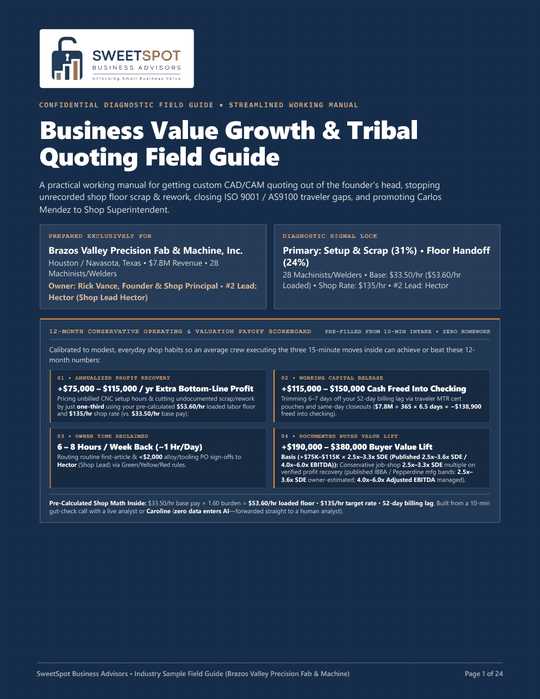
Protected preview · Click to launch the 24-page Precision Manufacturing ($7.8M) walkthrough
YOUR NEXT STEP
Two simple ways to get started.
Start with the free 5-minute online check, or book a 30-minute working call directly on Daniel Sweet’s calendar.
Take the 5-Minute Sale-Readiness Check
Answer 30 short questions on recurring vs. project mix, owner dependency, team depth, and clean financials. Your score and 12-month payoff preview appear immediately — no email required.
Start Free 5-Min Readiness Check Already took it? Order your $250 Custom Field Guide →Book a 30-Minute Working Call
Want direct operator help scoping a $2,500 Business System Inspection or $4,750 On-Site Diagnostic? Pick a 30-minute slot on Daniel’s calendar or request an immediate callback.
Or send a message (reply within 1 business day) →FREQUENTLY ASKED QUESTIONS
Texas manufacturing & machine shop valuation questions.
What is my Texas manufacturing or machine shop business worth?
Smaller owner-operated Texas machine shops and fabricators commonly sell for roughly 2.8x to 3.6x Seller’s Discretionary Earnings (SDE), while lower-middle-market manufacturers with a plant manager and diversified customer base commonly trade at 4.0x to 6.0x+ EBITDA, based on IBBA Q4 2025 and Pepperdine Private Capital Markets benchmarks. These are published market ranges, not a formal appraisal of your company.
Is equipment value added on top of the SDE or EBITDA multiple?
Usually no. In most cash-flow-based manufacturing sales, the operating machinery and equipment required to generate the earnings are included inside the SDE or EBITDA multiple (alongside normal working capital), unless the business is being sold in an asset liquidation or carries verified surplus equipment and real estate priced separately.
What raises a manufacturing valuation multiple the most?
Diversified customer revenue (no single customer above 15%), repeat blanket purchase orders or proprietary products, documented ERP quoting and BOM routings that do not rely on the founder, and a plant manager who passes the 90-day owner absence test push multiples toward the top of the range.
What lowers a machine shop or fabricator’s multiple?
High customer concentration (one customer over 30% of sales), founder-dependent quoting, deferred CNC or press-brake capex, and unverified inventory or WIP balances all lead buyers to lower their multiple or shift price into contingent earnouts.
Where do these manufacturing valuation numbers come from?
Our published ranges cite the IBBA / M&A Source Market Pulse Survey (Q4 2025), the Pepperdine Private Capital Markets Report, and BizBuySell 2021–2025 manufacturing closed-deal benchmarks (checked November 5, 2026).
Are you a business broker or M&A investment bank?
No. SweetSpot is not a broker and not an investment bank — we do not list companies, run buyer auctions, or take a closing commission. We work on site for fixed, published fees to fix operational, quoting, and financial diligence gaps 1 to 3 years before you sell or transition to management.